
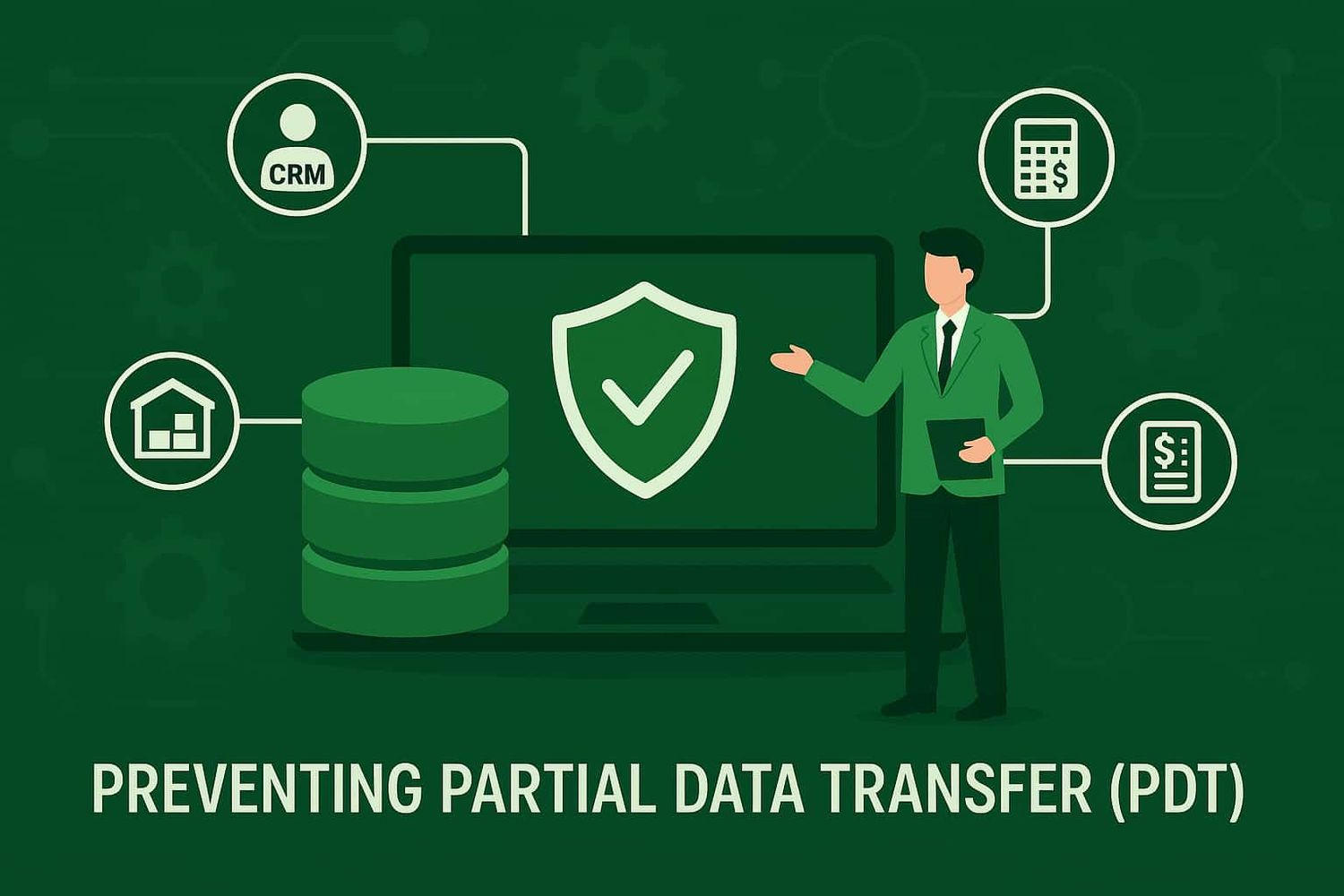
System integration between Customer Relationship Management (CRM), Payroll, and Inventory systems with core Accounting Software ensures accurate and real-time financial visibility. These integrations eliminate manual entry and maintain a unified financial data source across the organization.
A Partial Data Transfer (PDT) occurs when an automated data synchronization process starts but fails to complete before the transfer window closes. As a result, only a portion of the expected dataset reaches the accounting software, creating discrepancies between operational and financial records.
Such incomplete transfers are often traced to two core causes — API Timeouts and Integration Failures — both of which disrupt the transaction flow between source and destination systems. When these failures occur, the accounting software receives inconsistent or missing data that silently alters financial statements, resulting in understated or overstated values across the General Ledger, Balance Sheet, and Profit and Loss accounts. In some cases, these symptoms resemble technical faults seen in accounting platforms like Error Code 80029c4a in QuickBooks, where missing or corrupted system files interrupt normal data operations and cause partial transaction processing.
This article provides a comprehensive framework for identifying, handling, and preventing Partial Data Transfers (PDT). It defines the technical characteristics of PDT, categorizes its financial risks across CRM, Payroll, and Inventory systems, and establishes recovery and prevention mechanisms through idempotent integration, delta synchronization, and event-driven architecture. The goal is to achieve financial certainty by ensuring that every data movement between integrated systems is complete, validated, and auditable.
Understanding the Mechanism and Financial Impact of Partial Data Transfer (PDT)
A. Definition and Technical Scope of Partial Data Transfer (PDT)
A Partial Data Transfer (PDT) refers to an incomplete exchange of information between interconnected systems, such as CRM, Payroll, Inventory Management, and Accounting Software. In a successful integration, all data packets transmitted from the source system reach the target system without interruption. During PDT, however, the transfer process terminates before completion, resulting in missing records or unbalanced transactions.
The underlying causes of PDT are primarily API Timeouts and Integration Failures.
API Timeout occurs when the sender or receiver system takes longer than the permissible response window, often due to bandwidth limitations, rate throttling, or network congestion.
Integration Failure arises when the data payload structure does not match the target system’s schema. This may include missing mandatory fields (such as Tax ID or Cost Center Code), incorrect data mapping, or incompatible field types.
These failures are recorded in integration logs as response codes and error traces. Codes in the 4xx range (Bad Request, Unauthorized Access) indicate mapping or validation errors, while 5xx codes (Service Unavailable, Gateway Timeout) reflect system or server-side delays. Each error signal provides a precise technical reference for identifying where the transfer was interrupted.
Monitoring these codes and maintaining accurate log documentation form the first layer of detection. A consistent review of such logs ensures that incomplete data transfers are flagged before they influence financial reporting or reconciliation processes.
B. Financial Risk and Impact Assessment of PDT
A Partial Data Transfer creates silent accounting discrepancies that can remain undetected within financial records. Unlike a total integration failure, where missing data is immediately visible, PDT produces an illusion of completeness — some records appear valid while others remain absent. This condition results in distorted balances and untraceable audit variances.
The most critical risk emerges within the General Ledger (GL), where incomplete entries cause an imbalance between debits and credits. For instance, if invoice headers are transferred from a CRM system without corresponding line items, revenue remains understated even though customer accounts appear active. Similarly, when payroll expense data transfers without its matching liabilities, the company’s balance sheet falsely reflects lower obligations.
In financial terms, PDT leads to:
Understated or Overstated Revenue – due to incomplete invoice or sales line transfers.
Unbalanced Journal Entries – when debit and credit totals diverge.
Inaccurate Liabilities – resulting from missing tax or deduction components.
Erroneous Asset Valuation – when inventory receipts or cost data are only partially posted.
Such inaccuracies propagate through consolidated statements and cause material misrepresentation of financial performance. Therefore, early detection and structured recovery are essential for preserving data integrity and audit reliability.
Handling and Prevention Strategies for Partial Data Transfer (PDT)
A. Handling Strategy for Partial Data Transfer Failures
Once a Partial Data Transfer (PDT) is detected, the recovery process must ensure that lost data segments are restored without duplication or corruption. This requires an approach centered on detection, validation, and controlled reprocessing.
1. Immediate Detection and Alerting
Automated monitoring systems must track all transactional API responses between source and destination platforms. Each call should log its response status and timestamp.
Status Codes 4xx indicate configuration or mapping errors that must be corrected at the integration layer.
Status Codes 5xx signal temporary failures such as timeouts or unavailable endpoints.
When a failure is recorded, the monitoring framework should issue a real-time alert to both technical and finance teams, enabling rapid intervention before financial postings are finalized.
2. Data Validation and Reconciliation
After detection, the next phase ensures that only missing or corrupted records are present.
Batch ID and Checksum Comparison: Each data push must include a unique identifier or checksum. The receiving system records the same ID, allowing direct comparison between transmitted and posted records.
Delta Synchronization: Only records that were not successfully logged under a valid Batch ID are re-sent. This prevents duplication.
Suspense Account Routing: When the system cannot verify if a transaction was received, that record should be temporarily held in a suspense account until manual verification is complete. This maintains balance integrity in the General Ledger (GL).
3. Idempotency and Controlled Retry Logic
An idempotent integration ensures that identical requests never produce multiple entries. Before posting, the receiving system verifies whether the transaction with the same Source ID already exists.
For transient network issues, automated retries must use exponential back off intervals to avoid system overload while improving success rates.
B. Prevention and System Resilience Framework
Preventing PDT requires structural optimization at both the data architecture and integration logic levels. Proactive design minimizes the chance of incomplete synchronization and ensures predictable system performance.
1. Data Chunking and Batch Optimization
Transferring smaller, consistent data blocks reduces the probability of timeouts. For example, instead of sending 10,000 transactions in one batch, the system can push 500-record segments sequentially. Each batch is validated before the next begins, ensuring contained recovery in case of interruption.
2. Event-Driven Architecture (EDA) and Webhooks
In an event-driven design, the source system notifies the destination system immediately when an event occurs, such as invoice creation or payroll posting. This eliminates the need for large, scheduled batch transfers. Each transaction is sent as a discrete, validated event, minimizing the impact of any single failure.
3. Data Transformation and Schema Validation Layer
Before transmitting data, a transformation layer must verify that all required fields are populated and match the target schema. Invalid or incomplete records are routed to an error queue for correction. This pre-validation step prevents failures from propagating downstream.
4. Mapping Documentation and Version Control
Accurate field mapping ensures that structural changes in source systems do not create integration mismatches. Maintaining an up-to-date mapping document and version log allows both developers and accountants to trace any modification that could affect synchronization accuracy.
Implementing these measures creates a resilient data ecosystem where PDT occurrences are either eliminated or easily recoverable. Each control point—monitoring, reconciliation, idempotency, and pre-validation—acts as a safeguard to maintain financial consistency across integrated systems.
Conclusion!
Partial Data Transfer (PDT) represents a critical vulnerability in multi-system financial integrations. Even when data synchronization appears successful, incomplete transmissions can silently distort the accuracy of accounting records. These inconsistencies weaken audit reliability, delay reconciliations, and misstate key performance indicators.
Effective handling of PDT depends on three operational principles: early detection, precise reconciliation, and structured prevention. Detection mechanisms use API response monitoring and error code tracking to identify failures in real time. Reconciliation frameworks based on Batch ID comparison and Delta Synchronization restore lost entries without duplication. Preventive architectures — including idempotent APIs, event-driven integrations, and transformation validation layers — ensure that data remains complete and compliant throughout the transfer cycle.
A resilient integration ecosystem not only mitigates PDT but also strengthens financial control across CRM, Payroll, and Inventory systems. Consistent monitoring, defined recovery protocols, and governed mapping documentation guarantee that every transaction entering the accounting software is accurate, validated, and auditable.
Future integration frameworks will increasingly adopt AI-driven anomaly detection and predictive error diagnostics to anticipate PDT-like events before they occur. By embedding such intelligence within middleware platforms, businesses will move from reactive error correction to proactive data assurance — achieving continuous financial integrity in every system interaction.
Frequently Asked Questions
What is Partial Data Transfer (PDT) in system integration?
Partial Data Transfer (PDT) occurs when data synchronization between interconnected systems, such as CRM or Payroll software, stops before completion. This results in missing, incomplete, or unbalanced transactions that cause accounting inconsistencies and financial misrepresentation across reports and ledgers.
How do API Timeouts lead to Partial Data Transfers?
API Timeouts occur when the receiving or transmitting system fails to respond within a defined period. This interruption halts the data flow, leaving only part of the dataset transferred, which can distort General Ledger balances and cause understated or overstated financial results.
What financial risks arise from Partial Data Transfers?
PDT creates silent accounting discrepancies by allowing partial information to enter financial records. These errors lead to inaccurate revenue reporting, unbalanced journal entries, misstated liabilities, and valuation mismatches in inventory assets, directly affecting financial integrity and audit reliability.
How can organizations detect and correct Partial Data Transfers?
Detection depends on real-time monitoring of API responses, error codes, and transaction logs. Correction involves checksum comparison, delta synchronization, and suspense account isolation, ensuring that only missing entries are reprocessed without creating duplicate records within the accounting system.
What are the best practices to prevent future Partial Data Transfers?
Prevention relies on architectural design improvements, including idempotent API logic, event-driven synchronization, batch size optimization, and schema validation layers. These measures ensure complete, validated, and auditable data exchange between all integrated systems without loss or distortion.